
ChatGPT Ads: Check These Three Things Before You Spend
Imagefactory Engineering · Published 2026-08-14
ChatGPT Ads have been live for about six months. There is no minimum spend, and ads now serve in eight countries, so you can open an account today and start testing. Yet on the same channel, some agencies burned through their entire budget without a single conversion, while another posted 1.49x ROAS.
This post looks at where that gap comes from, using OpenAI's own documentation and measured results published by agencies running real accounts.
Contents
- Cheap inventory, and demand that doesn't overlap with your other channels
- Is now the moment for ChatGPT Ads?
- A checklist for whether your product will sell there
Cheap inventory, and demand that doesn't overlap with your other channels
CPM halved in nine weeks
When the pilot opened in February 2026, CPM was $60. By 17 April it had come down to $25–45.
A price cut of that size in nine weeks means inventory is growing faster than demand. Advertiser competition is still thin, which makes this the cheapest window you will get on this channel.
It picks up leads that never showed in Google Search
Similarweb measured overall CTR at 0.68% in May 2026, falling to 0.50% by July. Set against Google Search's 6.64% average, that looks like a different order of magnitude.
But the two are not competing for the same demand. 83% of the queries that triggered a ChatGPT ad would not have surfaced a Google Shopping ad at all. If your Google Search bids are already saturated, treat this as inventory that picks up what Google misses, not as a replacement for it.
Against display advertising's 0.35% average it actually reads high, and the top quartile sat at 1%. Clear 1% and you are in the top 25%.
People who click are more likely to convert
Visitors who arrive via AI buy well. Adobe Analytics measured AI-referred traffic in May 2026 converting 54% better than non-AI traffic, with 53% longer time on site and 23% more pages per visit. These are people who clicked after an extended back-and-forth with ChatGPT, so they arrive further along and stay longer.
Creative format matters too. CTI Digital, working with retail, ecommerce and travel clients, found that creative that reads like part of the answer hit 1.26% CTR against 0.66% for conventional commercial ads — roughly double.
The trade-off is expensive clicks
OpenAI's suggested starting bid is $3–5 per click. In practice, ads only start delivering somewhere around $10. The cases below burned their budgets in the $9–13 range, and Booyah Advertising's cross-platform index put OpenAI's cost-per-click at more than five times Meta's.
The reason is scarcity: ads sit below the answer, and there is at most one per response. The clicks cost more, but that single slot sits in front of someone who has already done their research.
Is now the moment for ChatGPT Ads?
Four that failed, one that worked
| Advertiser | Spend | Result |
|---|---|---|
| Symphonic Digital | $500 | 53 clicks, 35 GA4 sessions, zero leads. ~$9 average CPC |
| Out of the Box Advisors | $500 | Spent in one hour. ~140 clicks, zero enquiries or form fills |
| adlibrary.com | $200 | ~5,000 impressions, ~40 clicks, zero conversions |
| Grow My Ads | $1,200 | 92 clicks, $13 average CPC, $120 CPM, zero conversions |
All four are small self-reported tests, not industry benchmarks. Against them, Opascope spent roughly $60,000 over 15 days and returned $89,000 in revenue at 1.49x blended ROAS (a single account over 15 days, so treat it as a ceiling rather than a benchmark). Three things come out of that contrast.
- Leave the bid at OpenAI's suggested $3 and your ads will not run. All four cases only started spending once they pushed to $9–13. Plan for around $10 from the start.
- B2B performed better. Eight of the top ten advertisers by impression share are B2B software, and the top five — Monday.com, Shopify, Jotform, Resume.io, Cursor — are all products an individual buys directly.
- The longer the consideration cycle, the better it works. Ads appear on average at the 14th to 22nd conversational turn, which puts them in front of someone who has already narrowed the field.
Where you can run them today
You can open an advertiser account in seven countries — the United States, United Kingdom, Canada, Australia, New Zealand, Japan and South Korea — and ads serve in eight, adding Brazil (as of 6 August 2026). The minimum spend commitment was dropped when self-serve opened up on 5 May 2026, so anyone can open an account and start testing.
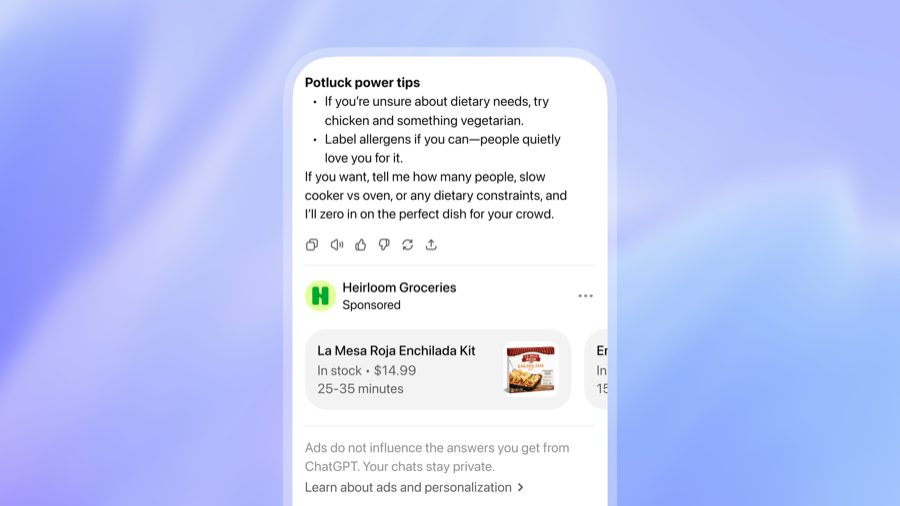
Ads sit after the answer ends, separated by a divider and labelled with a favicon and a Sponsored tag. They never interrupt the answer or blend into it.
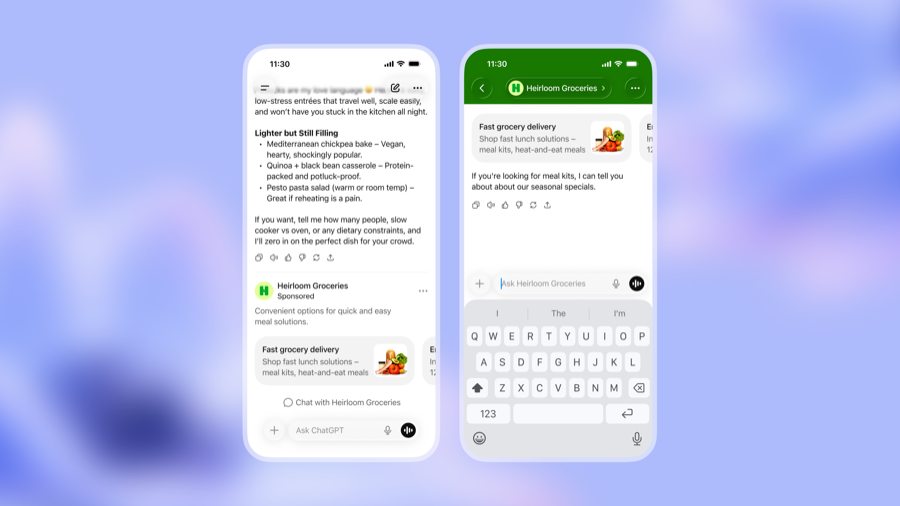
Some formats open a conversation with the brand rather than a landing page. The header colour and the input placeholder change to the brand's.
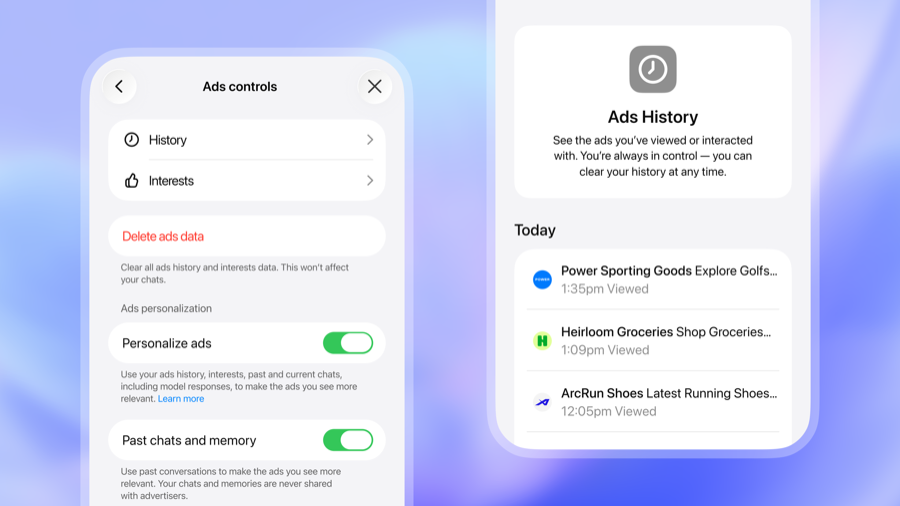
Users can tap the three dots to see why an ad appeared, or turn off ad personalisation in settings. Turning personalisation off does not stop ads tied to the current conversation. For advertisers, that means the more your hints read like interest keywords, the more your performance swings with that toggle — and the more they read like real sentences, the less it matters.
How to start
The opportunity is real: inventory is cheap and competition is thin, but that window closes as advertisers arrive.
Carrying over habits from other channels is what leaks budget. ChatGPT Ads look like search ads, but the thing choosing which ad to show is a model, not a person. That changes the order you work in.
-
Settle your country, billing currency, time zone and bidding type before you create the account. None of the four can be changed afterwards — switching currency means starting a new account and leaving your conversion history behind. Check that your robots.txt is not blocking
OAI-AdsBotwhile you are at it, because ads will not clear review if it is. -
Budget at least $900, ideally $1,300 or more, for the first test. At more than $10 a click, that is what it takes to buy the ~100 clicks you need before any read on creative is meaningful.
-
Start with a single ad group. Meta and Google let you set a budget per ad group. ChatGPT Ads has no such field — budget attaches to the campaign only. Split into several groups and whichever one responds best consumes nearly all of it, leaving the others with too few impressions to judge.
-
Write targeting as sentences, not keywords. Matching runs on conversational context, not exact keyword match. "Interior design" sits far from how someone actually asks ("recommend a sofa for a small studio apartment"), and the distance costs you match quality. OpenAI's suggested axes are goal, situation, constraint and trade-off — the more you weave together, the tighter the match.
-
Spend your 16–24 character headline on the one thing a competitor cannot claim. Use a square image, and put the product in it rather than your logo. Geographic targeting stops at country and region, and there is no device, age or gender targeting at all, so the only levers you actually control are the hint sentences and the creative.
-
Build a dedicated landing page for the campaign. ChatGPT's native reporting will not show you revenue.
A checklist for whether your product will sell there
Three questions. All three yes and it's worth starting; any one no and it's worth waiting.
- Are your customers on the free plan? Ads only serve to free and Go tier users.
- Can you put at least $900 into a first test? Clicks run north of $10 on this channel.
- Are you outside the restricted categories? Legal, financial, gambling, medical, pharmaceutical, weapons, political, dating and alcohol advertising is blocked or heavily restricted.
Running ChatGPT Ads with ImageFactory
ImageFactory supports ChatGPT Ads natively. We connect to OpenAI's advertising API, so you can run it alongside Meta, Google, Naver, Kakao and TikTok — six channels on one screen.
Once you've cleared the checklist, the build is next, and we take the heavy part of it.
- We write the strategy and the copy with you. Give us a product page URL and we'll work out who to target with what message, then produce headlines and descriptions that fit the spec.
- We show you the real ad card before it ships. You see whether your text truncates and fix it on the spot, so there's no build-check-rebuild loop.
- Campaign setup and reporting happen in conversation. Anything that spends money shows you a preview first and only runs once you approve it.
Want to know whether ChatGPT Ads suit your product before you commit? Request a free consultation and we'll analyse your category and budget, then propose a strategy.
Read next: Run ads straight from the AI you already use — ImageFactory MCP · How to write ad hooks that convert
Frequently asked questions
Q. Which plans see ads? Only the free tier and the Go tier, for signed-in adults. Plus, Pro, Business, Enterprise and Edu accounts see no ads, and neither do accounts belonging to under-18s.
Q. Does ChatGPT share my conversations with advertisers? No. Advertisers receive aggregate performance data such as impressions and clicks. They have no access to conversations, history or memory.
Q. Can users turn ads off? Free users can switch ads off in exchange for reduced usage limits. Ad personalisation can also be turned off separately in settings, though ads based on the current conversation continue to appear.
Q. What does it cost? The minimum spend commitment was removed on 5 May 2026. CPM fell from $60 in February 2026 to $25–45 by April, and OpenAI suggests a starting maximum bid of $3–5 per click. No first-party data on actual winning CPC has been published, and several advertisers report needing $9–13 before ads delivered at all.
Q. What are the creative specs? Headlines of 16–24 characters and descriptions of 32–48 characters are recommended, against API limits of 50 and 100. Images are 1:1 square, and your brand favicon must be at least 128×128px. OpenAI's guidance is explicit that your logo should not be the main visual.
Q. What do I need on my website?
A conversion pixel, and a robots.txt that does not block OAI-AdsBot. Blocking that crawler can stop your ads from being approved.
Figures are current as of 14 August 2026. OpenAI revised its advertising policy four times in five months, so check the current rules before you launch.